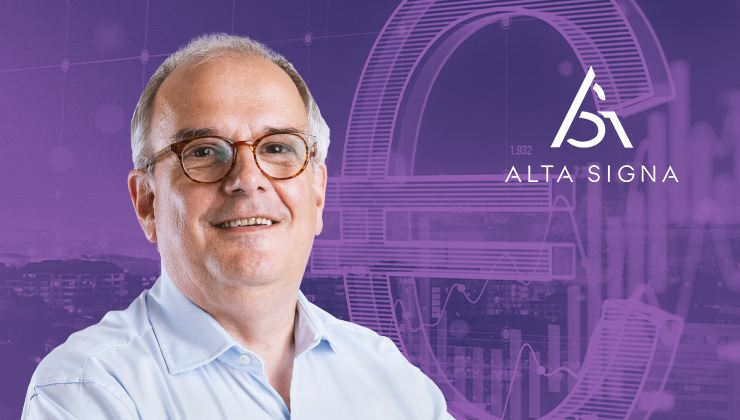
Our CEO Gerard Van Loon recently caught up with George Abbott, The Insurer’s Broadcast Reporter, to discuss the evolution of the European MGA landscape at the five year point in Alta Signa’s history in an exclusive interview with the publication’s video arm, The Insurer TV.
“You have a number of specialist MGAs – often domestic players – that are active in one or two countries, not more. Then you have a few Pan-European or cross-border MGAs. I would still say that a European-wide MGA is quite a unique value proposition for insurers. And I think it is also quite an important proposition because the insurer gets the immediate risk diversification across the various countries without having to fight for a local market share. We can cherry pick the risks we like per country and then still build enough premium volume to make it sustainable both for us and our insurer partners.” Gerard says.
Navigating the soft market
Despite the soft market conditions for Financial Lines, Cyber and Marine, he remains “optimistic” as he touches on each of the business lines that the firm operates in. Here are his key takeaways.
He says: “It has been a rather challenging market recently. What we see is a clear softening of the market conditions, so being a relatively new player that is a real challenge for us– but we remain optimistic. We still see an increase in our submission flow, meaning that we have a reason to exist.”
Gerard notes that many people are still open to trade with Alta Signa with lots of open submissions converted to bound business.
“Overall, even if the market conditions are challenging, Alta Signa is doing a good job,” he adds. “During the startup phase, it’s fair to say that the portfolio was quite skewed to larger corporate risks. We traded mostly with the larger brokers, because they wanted to fill gaps in their programmes. Since then, of course there is less need to trade with a newcomer, so they tend to fall back on their traditional panel who provide solutions across all the lines of business.
“How do we try to compete? It’s really about looking for new niches. We are moving more towards the SME market, trying to trade with the smaller regional brokers in various countries. We also try to identify niches or product segments that are underserved. As an example, for the D&O line of business we are looking more at startup companies, and more generally those with the weaker financials and unproven track records. We are really trying to focus on the more difficult risks to underwrite where there is possibly less capacity or less supply of it.”
Capacity oversupply
On the current competitive environment, Gerard notes: “There is a clear oversupply of capacity, no doubt in the lines of business we are active in today: financial and professional lines, cyber and marine. Brokers and clients have an abundance of choice, no doubt. If you want to be successful in this challenging market, you must provide a unique sales proposition and in our case that is really focused on service. We try to respond as quickly as possible to insurance proposals, we also try to differentiate ourselves by underwriting the more difficult risks. And we are also of course trying to use technology as best we can to speed up the analytic process and provide solutions as quickly as possible to customers.”
In terms of the GWP split between the lines Alta Signa underwrites, he added: “Our portfolio is still skewed towards the financial and professional lines– that is the first line of business that we launched in the midst of a hard market back in 2019 to 2020. Since then, we have been looking for new growth opportunities. For example Cyber, which we thought would be a really interesting line of business in Europe– and this has been confirmed. We see more and more first-time buyers converting the insurance proposals inbound business.
“And then in 2024 we decided to expand into Marine– trying to tap into an uncorrelated insurance cycle, meaning not correlated to the FinPro insurance cycle.
Although Alta Signa doesn't have a specific target for the portfolio split, Gerard notes that “it looks like it will be a third for each line for the next three years.”
Cyber
Alta Signa has also been building out its Cyber portfolio. Gerard explains: “In the beginning it was hard work, clients were often asking for insurance proposals but the pickup was relatively modest. Clients then decided to delay their decision or not to buy the additional limit. So the conversion into bound business was quite low. But this has significantly improved over the last 12 months– we are seeing a real uptake in Cyber. There are multiple losses out there in the public: Jaguar Land Rover, the Co-op in the UK. Europe has been quieter but I think this may drive a client’s behaviour, meaning that they are now keen to buy higher limits or at least keen to buy the product. Also, due to an increase in the Cyber market premium volume, pricing has become far more attractive for buyers.”
With AI becoming more prevalent, there has also been talk in the industry of AI being a standalone insurance risk separate to Cyber as a line of business.
He continues: “If you look back at General Liability in the 1950s, it was one umbrella cover for all types of exposures. Today we have carved out Directors’ and Officers’ Liability, Product Liability, Environmental Liability– all based on claims activity. That trend makes perfect sense, and leads me to be possibly optimistic regarding AI because in the end: what is AI? It is an automatic generation of human knowledge, human analysis, human opinions etc, but its content is still very much created by human beings. So, you would expect the same type of errors and omissions as in other human activities. More of the same, but much faster.”
AI bubble bursting
In terms of the AI bubble bursting, Gerard agrees that there is “a lot of hype around AI currently that often leads to overvaluation of these companies” and at a certain point in time, he predicts a reality check.
“Share price volatility is always a sign of the potential burst of a bubble, which in turn could cause a ripple effect across the financial, professional and cyber lines of business. A burst may lead to grumpy shareholders and an abrupt interruption of promised business services. That will have to be dealt with like we did twenty years ago when the internet and fibre optic cables bubble burst. It will be a difficult few years.
The positive aspect for me is that this would change market conditions and create an opportunity for us. We are not that exposed to AI– Europe is not known for its number of technology companies, as a region it is a late entrants in the AI development race. Our portfolio is not as exposed to AI as possibly a US portfolio would be. We are also quite wary of consumer exposed businesses, such as large retail banks and large life insurance companies with retail asset management activities who tend to AI to service their customer services.”
Many thanks to George Abbott and The Insurer TV.